

Cordoba – three cultures
Cordoba is a city in southern Spain, in the Andalusia region and lies on the Guadalquivir River. Today, it is a major industrial, scientific, and tourist centre of global importance.
Just over a thousand years ago, Cordoba was the largest city in Europe. The city had more than half a million inhabitants. As a result of turbulent historical events and numerous conquests of this city, there were Muslims, Christians and Jews living side by side. The city was relatively tolerant and open to newcomers. Numerous travellers who visited Cordoba at the time shared knowledge and experience, which shaped the views of the local community.
Today Cordoba is the third (after Seville and Malaga) city centre of Andalusia. To trace the three cultures, we can visit numerous monuments that remain in the city today. In Cordoba’s heritage, we can easily find an enchanting blend of three cultures: Roman, Arab, and Jewish.
Cordoba – when is it worth coming?
Of course, nothing prevents you from coming here at any time of the year. However, it is worth considering whether, for example, you can accept 45-degree heat in summer or, during the Easter period, very high prices for accommodation and food. Below is a short calendar of the most important events:
Calendar of events
- January – on the 5th of January, there is a parade that passes through the streets of the city, led by the Three Kings. The parade is usually accompanied by an orchestra and a colourful and laughing crowd of cheering spectators. Children receive candy and sweets. The next day, try a traditional yeast ring-shaped cake: Roscón de Reyes.
- From March to June, the street kiosks offer fresh snails, prepared according to several different recipes. During this period of the year, orange trees bloom in the city, so the air is saturated with the smell of this fruit.
- During Easter, the Spanish celebrate the entire Holy Week. It is a period famous mainly for mysteries, self-flagellation of martyrs, and mystical processions passing through city streets. The processions are colourful and very loud. On the streets of Spanish cities, there are so-called “pasos”, huge platforms depicting religious scenes and accompanied by hooded members of various religious brotherhoods. Every year, during this period, numerous tourists come to Spain to take part in these ceremonial events. Worth knowing that prices for accommodation, food and transport in this period of the year can be doubled.
- May in Cordoba marks the beginning of the summer fiestas: the Cruces de Mayo festival– on patios and squares, the inhabitants are erecting crosses decorated with fresh flowers and colourful scarves. Typical tapas and wine are served, and flamenco music resounds around. People dance and have fun in the streets that day. Fiesta de Los Patios is a local competition for the most nicely landscaped and floral patio in the city, and Feria de Córdoba is a festival of dance and flamenco music.
- During the summer months in Córdoba, temperatures are very high. During the day, the thermometer often shows temperatures above 40-45 Celsius. Urban life returns only after sunset.
- From July to September, a dozen or so summer cinemas are set up in the city, and film screenings start after sunset. In July, the Festival of Cordoba takes place. It is an international festival of guitar music taking place in the gardens of the Alcazar.
- In autumn, you can enjoy a pleasant climate for walking around the city – it is still warm but not hot anymore. At the turn of September and October, the International Festival of Poetry – Cosmopoetica takes place (the event lasts 10 days).
- In December, the city begins preparations for the celebration of Christmas. The New Year, to be happy for us, should be welcomed in a Spanish way. According to tradition, it is believed that whoever eats 12 grapes during the bell’s striking will have a lucky and prosperous year. Local residents like to celebrate together; a popular meeting place is the clock in Tendillas Square.
Cordoba – how best to explore the city?
If you have more than one day to visit the city, you can use a tourist bus (Hop-on Hop-off) on one day and walk around the city on the second. The bus (25 euros) will take you to the most important attractions in Cordoba (17 stops). It will also let you move quickly between places. However, if you have only one day to visit the city, there is no way to see all its attractions and feel the atmosphere. If you have only one day, I suggest taking a walk (mainly around the Jewish quarter of Judería) and focusing on only a few city attractions.
For those interested in the tourist bus in Cordoba, I encourage you to visit the Cordoba City Sightseeing Bus website.
Cordoba – what is a must-see?
On the UNESCO list, the “Historic Centre of Cordoba” was inscribed in 1984 and 1994. On the UNESCO website, you can find the following description:
“Cordoba’s period of greatest glory began in the 8th century after the Moorish conquest when some 300 mosques and innumerable palaces and public buildings were built to rival the splendours of Constantinople, Damascus and Baghdad. In the 13th century, under Ferdinand III, the Saint, Cordoba’s Great Mosque was turned into a cathedral and new defensive structures, particularly the Alcázar de Los Reyes Cristianos and the Torre Fortaleza de la Calahorra, were erected.”

More information about Spain’s cultural heritage monuments can be found at UNESCO and UNESCO.org.
The Mosque–Cathedral of Cordoba – La Mezquita
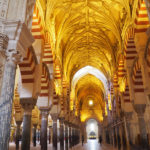
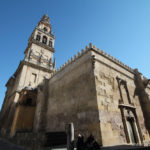
The Great Mosque of Cordoba is known as the “pearl of the medieval religious architecture of Islam”. It was built in the 8th century on the site of a church built in 600 by the Visigoths. The mosque has been rebuilt many times, but after the Reconquista in the thirteenth century, the Spaniards set up a Catholic church in the middle of the mosque. The reconstruction of the interior continued uninterrupted for several decades. In 1523, the mosque was finally transformed into a Catholic cathedral.
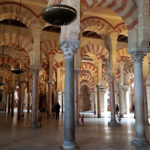
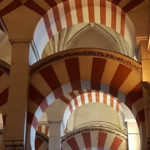
La Mezquita is one of the world’s most famous mosques and the largest former mosque in Europe. The mosque is known not only for its size but mainly for the famous hall with the “forest of columns”. Over 850 columns of marble, granite, and jasper make up the hall, and the mosque covers about 23,000 sqm. In 1984, UNESCO inscribed it on the World Heritage List.
The Great Mosque is worth visiting both day and night. It delights not only with its unusual architecture or beautiful decorative details but also with its size, acoustics and magically illuminated interior.







Great mosque – visiting hours:
- During spring and summer (III – X), sightseeing is possible between 10.00 a.m. and 7.00 p.m. from Monday to Saturday, and between 8.30 – 10.30 a.m. and 2.00 – 7.00 p.m. on Sundays and public holidays.
- In autumn and winter (XII – II), sightseeing is possible from 10.00 a.m. to 6.00 p.m., Monday to Saturday, and between 8.30 – 10.30 a.m. and 2.00 – 6.00 p.m. on Sundays and holidays.
Admission tickets: 10 Euro for an adult, 5 Euro for teenagers. Children under 10, city residents, and senior card holders have free admission.
More information about the mosque is available on the Great Mosque website.
The complex of Alcázar of the Christian Monarchs
The Castle of the Christian Monarchs was built on the foundations of a Roman fortress and an Arab palace. This is a strange place because the Catholic rulers who built it fought Muslims on the Iberian Peninsula, but their residence in Cordoba was built in the Arabic style. The works were initiated in 1328 on the orders of the king of Castile and Leon, Alfonso XI.


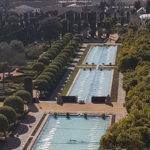
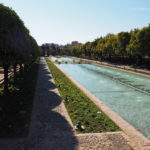
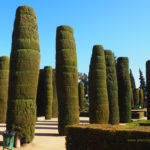
The castle interiors are not very interesting, but it is worth visiting for the gardens, which are the main attraction. Several fountains, ponds, and beautiful greenery are designed in the Arabic style. The spring garden smells of orange flowers, and in the summer, jasmine. It is a very pleasant place to relax.
Visiting hours: Tuesday to Friday from 8.30 a.m. to 7.30 p.m., and from 8.30 a.m. on weekends. to midnight. Entrance ticket: 4,5 Euro.
More information about the complex is available on the Alcázar website.






Casa Andalusi
The House of Andalusia is located in the heart of the Jewish quarter of Juderia, next to the old synagogue. The house, also called the “12th century Cordoba”, is not listed on the main list of tourist attractions of the city, but I strongly encourage you to visit it. This Museum-House opened in 1997, after a long-standing restaurant. It is a charming place that takes visitors back to the time of the caliphate, where you can feel the atmosphere of a past era. The house was built in an Andalusian style but mixed with Eastern styles and Arabic symbols. In front of the main entrance, a cosy courtyard features a small fountain and a beautiful little garden.


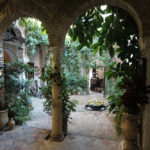


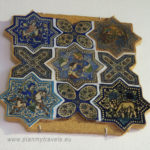
Inside, there is also a small Museum of Paper, where you can learn about the old production process of this material.
The house is characterised by beautiful architecture; it is filled with symbolism and colourful details. It is worth visiting and experiencing its magical atmosphere.
Admission tickets: 4 euros. The museum is open daily from 9.00 a.m. to 7.30 p.m. Address: Calle Judíos, 12


Roman Bridge
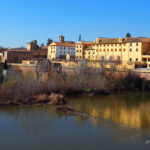
The Romans built the bridge on the Guadalquivir River at the beginning of the 1st century BC, probably replacing the previous wooden bridge. The present bridge was built in the eighth century, on the remains of a bridge erected by the Romans. It has 16 arcades, 1 less than originally, and a total length of 247 meters. The width is about 9 meters. For about 2,000 years, it was the only bridge on the Guadalquivir River to cross to the other side. Another bridge was built only in the mid-20th century. For centuries, the Roman Bridge was repeatedly restored and repaired, mainly in the tenth century. The last major renovation took place in 2006.
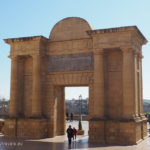
It is worth coming to the bridge after dusk because it is beautifully illuminated. At both ends of the bridge are two interesting buildings: the Calahorra Tower and the Bridge Gate, shaped like a triumphal arch. The Calahorra Tower houses the “Al-Andalus Museum”, an exhibition that shows daily life in Moorish Andalusia and the coexistence of Muslims, Jews, and Christians during the Middle Ages. Inside the Bridge Gate, there is also a small museum, but the main attraction is the observation deck at the top of the building.
Visiting hours:
- Al-Andalus Museum: during winter (from October to April) it is open from 10.00 a.m. to 6.00 p.m. From May to September, the museum is open from 10.00 a.m. to 2.00 p.m. and from 4.30 p.m. to 8.30 p.m. Entrance ticket: 4.5 euros
- The Bridge Gate: open from Monday to Thursday from 10.00 a.m. to 3.00 p.m., from Friday to Sunday from 10.00 a.m. to 2.00 p.m. and from 6.00 p.m. to 9.00 p.m. Entrance ticket: 1 Euro.
More detailed information about the museum in the defensive tower is available on the Calahorra Tower website.



Juderia
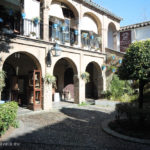
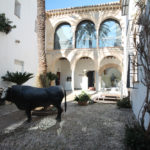
The former Jewish quarter is the perfect place to “get lost” for a while and stroll around to discover the beauty of the area. Our attention will certainly be drawn by the narrow cobbled streets, shaded courtyards, flowered gardens and balconies. A fifteenth-century synagogue stands here, the only synagogue in Andalusia to survive. There are several old, restored houses from the 12th – 14th centuries, which have been transformed into museums – today they bring closer the culture of their former inhabitants. The district also has an old Arabic market, “Zoco Municipal”, with numerous craft workshops. You can buy silver jewellery, colourful ceramics, or wooden items there. In Juderia there are many cafes and restaurants where you can taste Arabic or Jewish cuisine. In many small shops, you can buy aromatic herbs, spices, coffee or tea. The perfect place for an afternoon walk.




Cordoba – other attractions
In the city, other attractions are worth visiting if you have more than one day to do it. Unfortunately, I was only here for a few hours, so I didn’t have time for everything. Tourist guides recommend several more places:
- The Victoria Market (Mercado Victoria) operates in a 15th-century hall with a cast-iron construction. Here, you can not only eat well or do grocery shopping, but regular concerts and culinary workshops are also organised at the market
- Plaza del Potro – a square famous mainly due to Cervantes, because in the “Inn of the Colt” (Posada del Potro), the writer created fragments of “Don Quixote”. Currently, the building is the headquarters of the Flamenco Centre.
- Plaza de la Corredera – a square designed in the Castilian style. In the arcades surrounding the square, many cafes and taverns are open. There are also many souvenir shops.
- The Roman temple has 11 columns today, a replica of the 1st-century building erected in honour of Emperor Augustus. Some fragments of the original temple have been preserved, including parts of the altar and three capitals crowning the columns.
- Palac Marisa Viana is a Renaissance residence with a rich interior exhibition. It features numerous paintings, tapestries, antique furniture, book collections, porcelain, and firearms. The palace includes the Galería de Los Azulejos, decorated with over 230 paintings from the 13th to 19th centuries, arranged with ceramic tiles. The residence also features twelve traditional Andalusian courtyards and a botanical garden. You can find more information about the palace on the Palac Marisa Viana website.
Spain, my other posts
I encourage you as well to read my other posts about Spain: