

When I travel abroad, I like to visit big cities. I want to observe their culture and technology, visit modern and/or historical places, taste local cuisine, and enjoy the noisy nightlife. Therefore, whenever I can, I look for a one-day trip outside the big city.
This usually gives an entirely different perspective on the country, for instance, on its inhabitants and their lifestyle, as well as on culture, architecture, and nature. Everything that usually delights in a big city—splendour, momentum, bustling streets, loud clubs, and sumptuous restaurants—disappears as soon as you leave it. Only then can you see the whole picture.
I love such trips. I’m always excited about them because I never know what to expect or what will happen. Such places are rarely described in popular guidebooks, and there are no crowds of tourists. In conclusion, I love them and recommend them to anyone who wants to see more than the usual tourist paths. The trip “Budapest one-day outside city” is a perfect occasion for me to visit Hungary from a different perspective.
Budapest one-day outside the city. What to choose, where to go?
There are several offers on the market, and choosing one is not easy. You can decide, among others, for:
- Budapest Godollo Royal Palace Sisi Tour* – visit to Princess Sissi’s summer residence in Godollo (4 hours), from $67
- Full Day Private Guided Lake Balaton Tour with Lunch*: wexcursion to Lake Balaton (10 hours), from $314
- Day Trip to Bratislava from Budapest* – full-day trip to Bratislava, from $220
*Prices valid in 2026
Danube Bend Tour
„Danube Bend Day Tour from Budapest*” is a one-day outside city trip from Budapest around the Danube River. I booked it several weeks in advance. I also received all confirmations and vouchers a few days after. The trip plan included a visit to three historical places:
- Esztergom, where the largest and most important Christian Church in Hungary is located
- Visegrad – ruins of the royal palace and citadel, and a panorama of the Danube valley from the nearby hills
- Szentendre (St. Andrews) – colloquially called the “Artistic Mecca”- is considered the most beautiful small town in Hungary and one of the most beautiful in Central Europe.
The trip was about 9.5 hours long. We left Budapest on a tour bus and returned by a cruise ship. The trip’s price included lunch and entrance tickets to the Basilica in Szentendre.
Esztergom
It is one of Hungary’s oldest cities. The city was founded in the year 960 by Prince Gejza. In the place of the former Roman border watchtower, he established Hungary’s first capital. St Stephen was baptised and crowned in Esztergom in 1000. In 1224, the daughter of King Bela IV, St Kinga, was born in this place. Esztergom is the primatial seat of the Roman Catholic Church in Hungary.
On the other side of the Danube, there is the Slovak city Štúrovo (Párkány). Our first stop was on the Slovak side because, from the other side of the Danube River bend, it is the best place to see the basilica towering above the city.


The Cathedral of Our Lady of the Assumption and Saint Adalbert in Esztergom was created between 1822 and 1869. Its total area is over 5600 m2. The basilica is 118 m long and 49 m wide. The central dome has a diameter of 33.5 m and a height of 100 m from the outside.

You can visit the basilica daily, but during the year, the church, the underground crypt, the treasury, and the viewpoint on the dome’s roof open at different hours and on other days.
A detailed schedule can be found on the website of the Basilica, which is also available in several languages
Entrance tickets:
- Visiting the Church is free of charge for individual visitors
- Treasury – 1900 HUF* (~5,7$)
- Dome Lookout – 2800 HUF* (~8,5$)
- Crypt – 700 HUF* (~2,1$)
- Panorama Hall – entrance is free with a combination ticket to the Treasury and the Dome Lookout, or with a tourist guide ticket. For Individuals, the entrance fee is 2800 HUF* (~8,5$).
*Prices valid in 2025
Beware: the cathedral’s liturgical space will be closed to tourists 30 minutes before Mass. During services, the Church is open for worship only.


Visegrad
During the Roman Empire, on the rock towering over today’s Visegrad, the Romans built a border fortress. Later, a Slavic settlement was established here, and in the 9th century, the Hungarians took it over.
In the first half of the fourteenth century (1325), King Charles I built a castle in Visegrad, which served as the primary residence of successive Hungarian kings. The Upper Castle also served to secure the Hungarian royal insignia.
Visegrad lost its importance after the Hungarians were defeated by the Ottoman army at Mohács in 1526. In 1543, the Turks seriously damaged the castle, which was never used again. The city was reborn in the seventeenth century but regained its municipal rights in 2000.
When Visegrad was the capital of Hungary, it hosted Visegrad congresses, that is, meetings of the kings of Hungary, the Czech Republic, and Poland (in 1335 and 1338). The tradition of cooperation in Central Europe is being continued by the so-called Visegrad Group, created by the presidents of Hungary, the Czech Republic, Slovakia, and Poland. Presidents of these countries meet in Visegrad every year, beginning in 1991. Since 2016, on February 15th, International Visegrad Day has been celebrated.
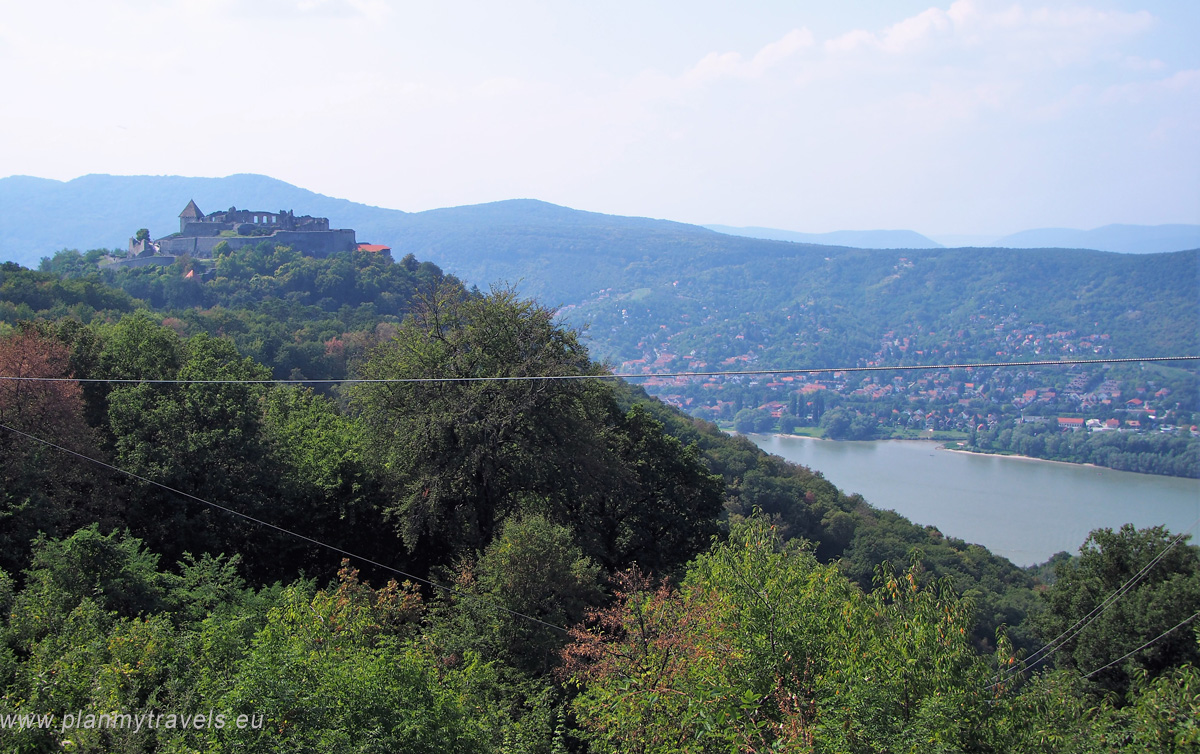
Currently, the town’s tourist attractions include a citadel and the ruins of the royal palace, both rich archaeological sites. Above all, it is worth taking in the panorama of the Danube Valley from the nearby hills.

Visegrad Nagyvillam Restaurant
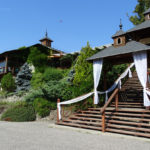
In Visegrad, we stopped at the Hungarian restaurant Nagyvillam for dinner. It was included in the price of our trip. This place is worth my recommendation -both for its tasty food and the beautiful views from its terraces.


More about Visegrad and its attractions you can read on visitvisegrad.hu
Szentendre (St. Andrews)
Szentendre is approximately 20 km from Budapest. You can easily get there from the city—directly by suburban train from Batthyany Ter station, or by a cruise passenger ship across the Danube.
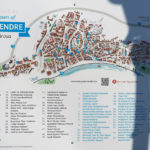
Szentendre is a picturesque town of artists. It has an unforgettable atmosphere, numerous museums, art galleries, narrow streets, interesting architecture, and a panoramic view of the Danube Bend. During the summer months, the town is teeming with life. It is often visited not only by tourists but also by the inhabitants of Budapest.
Szentendre is the so-called “city of artists” or “city of painters” because of the many artists who came here at the beginning of the 20th century.


The town also has many fascinating museums that house several sacred objects.
Ferenczy Museum Centre
The Ferenczy Museum was established in 1951 as the town’s local history collection and was named after the artist Károly Ferenczy. Today, the Ferenczy Museum Centre owns a uniquely rich collection of Szentendre’s paintings, graphic art, sculpture, and numismatic art. Open from Tuesday to Sunday, from 10.00 a.m. to 6.00 p.m. Entrance ticket: 3 000 HUF* (~9,1$).
Ceramics Museum
Kovács Margit Ceramics Museum, opened in 1973, is one of Szentendre’s most popular museums. The museum presents the work of ceramic artist Margit Kovács, a Kossuth Prize laureate. During the summer months, it is open daily (closed on Mondays) from 10:00 a.m. to 6:00 p.m. In the off-season, it closes at 4:00 p.m. Entrance ticket: 3 000 HUF* (~9,1$).
Open Air Museum
The Hungarian Open Air Museum presents Hungary’s folk architecture, culture, and lifestyle across eight regional units spanning 60 hectares. It is the largest museum in Hungary. It is located 3 km away from Szentendre. The Museum covers 312 different buildings arranged in 8 regional units. The Skanzen train runs from the Entrance Building to the Study Collection and back, providing comfortable transport. It runs every hour along the 2,2 km-long road and has five stops, all of which are easily accessible from the regional units. You can buy online tickets and avoid the queue. The daily train ticket costs 1300 HUF* (~3,9$)—more about the train you can find here: skanzen.hu_train.
- Between April and October, the museum is open Tuesday through Sunday from 9:00 a.m. to 5:00 p.m.
- The museum entrance ticket is 4000 HUF* (~ 12,1$) or 5000 HUF* (~ 15,2$) during the festival days. The Skanzen website has more information on how to get there from Budapest.
*Prices valid in 2025
During our trip to Szentendre, we walked with a guide who shared the town’s history and its main attractions. Then, we had about 1.5 hours of free time for independent sightseeing and shopping.
We returned to Budapest on a river cruise that departs from Szentendre Marina once a day at 5.00 p.m. The return journey took about 70 minutes.





Budapest one day outside the city. Final summary
The tour was fully professionally prepared and carried out. During such trips, there is never enough free time for self-sightseeing. However, on this trip, I think that we had enough time.
Within a few hours, we had the chance to get to know Hungary from a different perspective. We saw small towns, green suburbs of Budapest, beautiful churches, and picturesque views. During the trip, we also met interesting people, other participants, and got to know their motivations for visiting this part of Hungary.
Yes, travel can educate us, show different perspectives, broaden our horizons, let us meet interesting people, and help us better understand the reality around us. I am thrilled I found this trip and took advantage of it. Therefore, I recommend this form of sightseeing to anyone with similar needs as me: to expand endless horizons of knowledge and feed a constant hunger for visiting new places. In conclusion, a day outside the city is an excellent opportunity to meet those expectations.
Budapest – my other posts
I also encourage you to read my other posts about Budapest:
*Links to the offer from Klook are affiliate links
One Reply to “Budapest one-day outside city”