

written by: Fabio Brunello
Kazakhstan
“You know that in July I am going to Kazakhstan for work?” “In Kazakhstaaaannn??? Well, then I’ll come with you!”
As of this conversation, my wife Elisabetta and I have just begun exploring this Country, really unknown to both of us. We prepare ourselves by reading some travel guides (not so easy to find), watching Borat (a stupid movie far from reality) and mainly watching the web series Pascalistan, about the adventures of the Italian singer Pasquale Caprino, who’s a celebrity over there under the name of Son Pascal.
Kazakhstan – short historical background
Kazakhstan is a former Soviet Union republic with remarkable economic growth driven by oil and gas extraction. The country is vast, and since we have only a long weekend, we focus on Astana, the new capital, and the Northern territories.
Astana became the capital city only 20 years ago, at the decision of President Nazarbayev (in charge of the Presidency since the beginning of the Nineties…), and it is a city of around 850 thousand inhabitants, second only to Almaty, the historical capital city in the South.
Astana – Nur-Sultan, the new capital city
Going to Astana (since 2019 Nur-Sultan), you see a city under construction, with new buildings popping up everywhere, but all following a precise master plan defined 30 years ago. The left bank is the modern part of the city, whereas the right bank is more traditional but also more enjoyable for social life. My suggestion is to sightsee the monuments of the new area and also schedule a visit to the other side to get a better idea of how locals live.

Nur-Sultan – what to see?
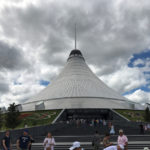
There are a plethora of buildings of strange shapes, some designed by well-known architects like Norman Foster. I suggest a walk of about 1 km from the shopping centre Khan Shatyr to the Presidential Palace to admire the buildings you can see on all the postcards and pictures of Nur Sultan. The most interesting is for sure Khan Shatyr, a family shopping mall. The structure is a huge tent – the biggest in the world – that can bear temperatures from -30°C in the winter to the hot summer. On the inside, there are classical shops with international brands like Levi’s and Adidas, as well as many unknown brands. There is also a food court with mainly fast food, many playgrounds for kids, and, on the top floor, a beach with a swimming pool!
The Bayterek Tower is the national symbol and represents a tree with a golden egg at the top, which connects to a legend about the origin of the Kazakh nation. Other interesting buildings are a pyramid-shaped building (Palace of Peace and Reconciliation) and the national circus, a building that looks like a UFO.


Walking through the city
Walking in the city is very safe, according to us; we didn’t encounter any issues, even though we were among the few non-Kazakhs or non-Russians. I have actually recognised that the local population had a very positive impression on us. They are very friendly and relaxed, and they care a lot about kids (who are many and can be found everywhere in parks and playgrounds).
Our visit coincided with Astana Day (a local bank holiday on July 6th), and the city was vibrant with markets, fireworks, and concerts across the city. Maybe this gave us a very positive view of the city, but we enjoyed it a lot!
Hotel availability is quite wide. We moved from the 400€ of Marriott to the 40€ of a small hotel where they speak only Kazakh and Russian, and we like them all (with the due differences) and feel warmly welcomed.
For the restaurant, we mainly tried street food as there was a wide variety for the National holiday. For sure, we can advise the restaurant Vechnoe Nebo (it means “Eternal Sky”), in the city centre, on the 25th floor of the Moscow skyscraper. It offers a spectacular view of the city, excellent service, and Turkic cuisine that covers the “–Stan” Countries (Kazakhstan, Uzbekistan, Kyrgyzstan, Turkmenistan, Azerbaijan, Turkey, and Uyghur cuisine). All of this for little money, for a great dinner for two, we paid 33€ in total!
I also visited the 2017 Expo, with the theme “the energies of the future”. Very interesting is the Kazakh pavilion, with each floor dedicated to different forms of sustainable energy (wind, solar, water, kinetic, …). The rest of the exhibition was very similar to other Expo events, such as Milan 2015, with a mix of “touristic” stands and others more closely linked to the main theme.


Kazakh Switzerland
Astana (Nur-Sultan) does not require more than 1.5 days of the visit, so for the other 2 days, we organised a tour of the natural park of Borovoe/Burabai through a local tour operator that provides a guide and driver. Borovoe, around 200km north of Astana, is often called Kazakh Switzerland, so we equipped ourselves with trekking shoes and technical clothing. Actually, we ended up among mountains and lakes, but in a place full of tourists, locals and Russians, with a beach as full as Rimini or Ibiza in August!
This, anyway, allowed us to immerse ourselves in the local culture and have a real “Kazakh experience”, learning how locals enjoy their holiday, what they bring for a picnic, and what they eat. “Manti” (big dumplings stuffed with meat and steam-cooked, like Chinese bao xian) and “samosa” (sort of sandwich with cheese or minced meat), bought at local shops on the street, are actually extremely tasty!
The morning after, we did a beautiful walk around the lake, following a path through the forest, whereas the mountain climb was abandoned quite soon since it looked quite dangerous. Our guide was a nice 23-year-old girl, but without any hiking or climbing experience!

Local family experience
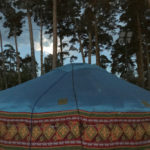
The best moment of the trip, however, was a visit to a local family. They rebuilt a yurt (a traditional tent of nomadic peoples in Central Asia) in the steppe to host tourists. We had lunch with them, eating food prepared by our host. We could chat with her and her husband, a farmer with a passion for hunting with the eagle on the steppe! Social media craziness is also here, with our hosts ready to take a picture with us to post it immediately on their Facebook profiles! Actually, the trends are becoming increasingly globalised, as you can see here with kids playing with the widget spinners, and you can listen to Despacito on every radio station!


Our final thoughts about Kazakhstan
Kazakhstan, from this unknown place at the beginning, is for us now a warm, welcoming country. There are people who live in good economic circumstances and have high hopes for the future. A Country that wants to grow, full of kids and structures for kids (what a shame not to have brought our kids, fearing it was unsafe for them). It is probably not the most beautiful Country from a historical or natural point of view, but it is certainly a beautiful discovery and worth a visit.
Fabio & Elisabetta
Useful links:
- Expo 2017 Astana
- Astana Medical University
-
Unlimited Data eSIMs for Kazakhstan (QR Delivered via Email)*
Kazakhstan Health Entry Pass
You can apply online now for your Kazakhstan Health Entry Pass with iVisa.com before your arrival. It’s easy and fast with us. See below for details on how to apply.
Health Declaration
- Health Entry Pass: A health questionnaire that must be filled out within 72 hours before departure
- Validity: Valid on entry to Kazakhstan
- No. of entries: Single-entry document
- Fees: iVisa.com charges a processing fee
- Eligibility: Required for all passengers eligible for travel to Kazakhstan
- Passport requirements: Valid for at least 6 months after the date of entry.
If you’re ready to get started on your journey to Kazakhstan, click here to apply for the Kazakhstan Health Entry Pass*.
Other stories by Fabio Brunello
I also encourage you to read other stories written by Fabio, published on the PlanMyTravel Blog:
- Thailand: nature, culture, and beach!
- Kraków and Lesser Poland
- Transylvania and Bucharest: visiting Count Dracula
*Klook and iVisa links are affiliates